Strength Standards
Compare your one-rep max (1RM) and multi-rep lifts against evidence-based Strength Standards for men and women. Select an exercise below to view exact pounds (lb) and kilograms (kg) benchmarks across Beginner, Novice, Intermediate, Advanced, and Elite tiers.
Select an Exercise to Compare Your Strength
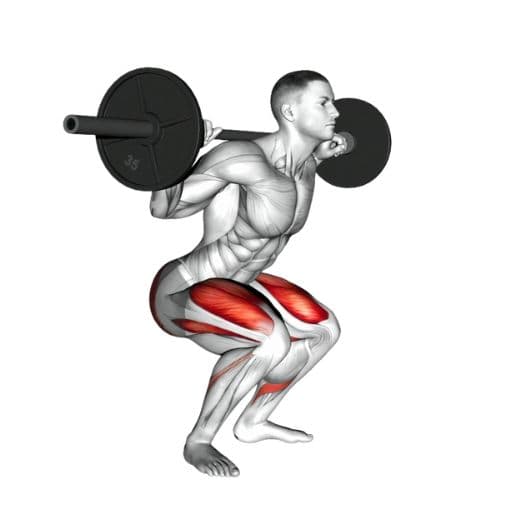
Squat Strength Standards
Primary Muscles: Quadriceps, Glutes, Hamstrings, Erector Spinae, Core
Compare your barbell back squat one-rep max (1RM) against bodyweight and age standards for men and women. The squat is the cornerstone lower-body movement and the first competition powerlift. Includes a live 1RM estimator, strength rank assessment, personalized rep-max training zones, and a shareable strength card.
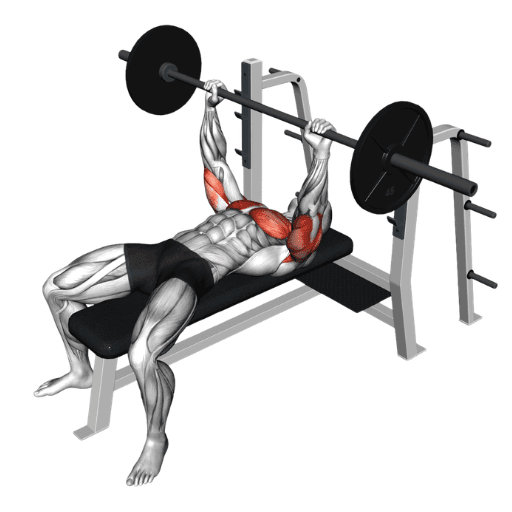
Bench Press Strength Standards
Primary Muscles: Pectoralis Major, Anterior Deltoids, Triceps Brachii
Compare your flat barbell bench press one-rep max (1RM) against validated bodyweight and age standards for men and women. Includes a live 1RM & strength rank calculator, personalized rep-max training zones, and a shareable strength card.
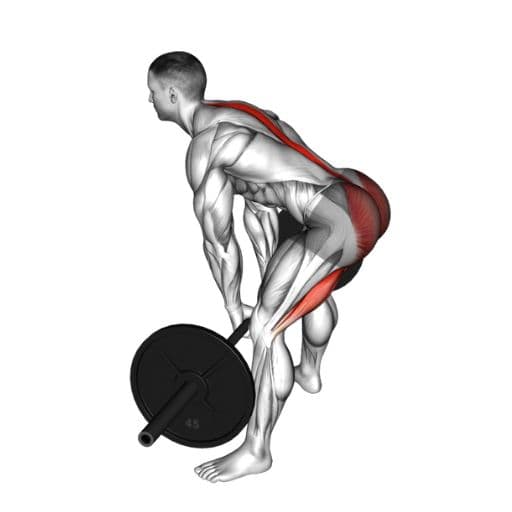
Deadlift Strength Standards
Primary Muscles: Hamstrings, Glutes, Erector Spinae, Lats & Traps
Measure your conventional or sumo barbell deadlift one-rep max (1RM) against bodyweight and age standards for men and women. Includes an interactive 1RM estimator, posterior-chain strength rank assessment, rep-max training zones, and a shareable strength scorecard.
The 5 Strength Standards Levels Explained
Every exercise in our Strength Standards database classifies lifters into five progressive experience levels based on relative strength (1RM ÷ Bodyweight) and training age:
| Strength Level | Typical Training Experience | Trained Population Rank | What This Level Represents |
|---|---|---|---|
| 1. Beginner | 1 – 6 Months | Stronger than ~15% | Stronger than an untrained individual; has learned proper barbell mechanics and full range of motion. |
| 2. Novice | 6 – 12 Months | Stronger than ~35% | Consistent weekly linear progression; solid foundational strength across primary compound movements. |
| 3. Intermediate | 1 – 3 Years | Stronger than ~60% | The community average benchmark for a dedicated gym lifter; requires structured periodization to progress. |
| 4. Advanced | 3 – 5+ Years | Stronger than ~85% | Multi-year dedication to strength training; among the strongest lifters in most commercial gyms. |
| 5. Elite | 5+ Years | Top 3–5% of lifters | Competitive powerlifting standard; exceptional genetic leverage and multi-year peaking specialization. |
How Strength Standards Are Formulated
Our Strength Standards combine relative bodyweight ratios, validated 1RM prediction equations, and age-scaling coefficients:
1. Bodyweight Ratio Normalization (Pound-for-Pound Strength)
Comparing raw weight lifted without accounting for body size is misleading. By dividing your 1-Rep Max (1RM) by your Bodyweight, our standards allow a 150 lb (68 kg) lifter and a 220 lb (100 kg) lifter to measure their relative strength on a level playing field.
2. Submaximal 1RM Prediction (Epley Equation)
You do not need to risk a maximal single-rep lift to find your strength level. Entering any working set of 2 to 10 repetitions uses Boyd Epley's formula (1RM = Weight × (1 + Reps ÷ 30)) to compute your 1RM and corresponding working percentages automatically.
3. Strict Full Range-of-Motion Execution
All Strength Standards assume raw (unequipped) lifts performed with a standard 20 kg / 45 lb Olympic barbell through a complete range of motion—such as touching the chest under control on the bench press and reaching full joint lockout on every repetition.
Frequently Asked Questions About Strength Standards
What are strength standards and how do they work?
Strength standards are normalized performance benchmarks that compare your One-Rep Max (1RM) against your bodyweight, biological sex, and age. Instead of comparing lifters of different sizes using raw weight alone, strength standards use bodyweight ratios (1RM ÷ Bodyweight) to classify lifting performance into five progressive tiers: Beginner, Novice, Intermediate, Advanced, and Elite.
What is considered an average or Intermediate strength standard?
In strength training databases, the Intermediate tier represents the average benchmark for a consistent gym lifter with roughly 1 to 2 years of structured barbell training (stronger than ~50–60% of gym lifters). For example, on the Barbell Bench Press, the Intermediate strength standard is 1.25× bodyweight (212 lb / 96 kg average) for men and 0.75× bodyweight (112 lb / 51 kg average) for women.
Do I need to test my true 1-Rep Max (1RM) to use strength standards?
No. Every StrengthRegimen exercise standard page includes a built-in submaximal 1RM estimator powered by the validated Epley equation: 1RM = Weight × (1 + Reps ÷ 30). Simply enter any set of 2 to 10 repetitions (such as 185 lb × 5 reps or 80 kg × 5 reps) to instantly calculate your estimated 1RM and strength level safely.
How do bodyweight and age affect strength standards?
Because muscle cross-sectional area scales quadratically (L²) while body mass scales cubically (L³), lighter lifters naturally achieve higher bodyweight ratios while heavier lifters press greater absolute loads. Additionally, neuromuscular force output peaks between ages 20 and 30 (1.00× factor) and gradually scales down after age 35–40, which our age-adjusted tables account for automatically.